

Every company has daily tasks that consume more time than they should. This can happen across project coordination, documentation, customer follow up, field reporting, internal approvals, technical information, sales processes or data analysis.
These are not always major problems. Often, they are small recurring tasks that gradually take space from the work that matters most.
This is where the right apps, platforms and digital workflows can make a real difference. Not because tools solve everything by themselves, but because they help teams save time, reduce rework and focus on what matters.
For many companies, the problem is not lack of effort. Teams already work hard. The real challenge is often operational friction, scattered information, repeated manual tasks, disconnected tools, unclear ownership and decisions made without enough visibility.
Better tools do not replace expertise, they support it. They make information easier to find, tasks easier to follow, decisions easier to support and delivery easier to repeat.
The cost of fragmented work
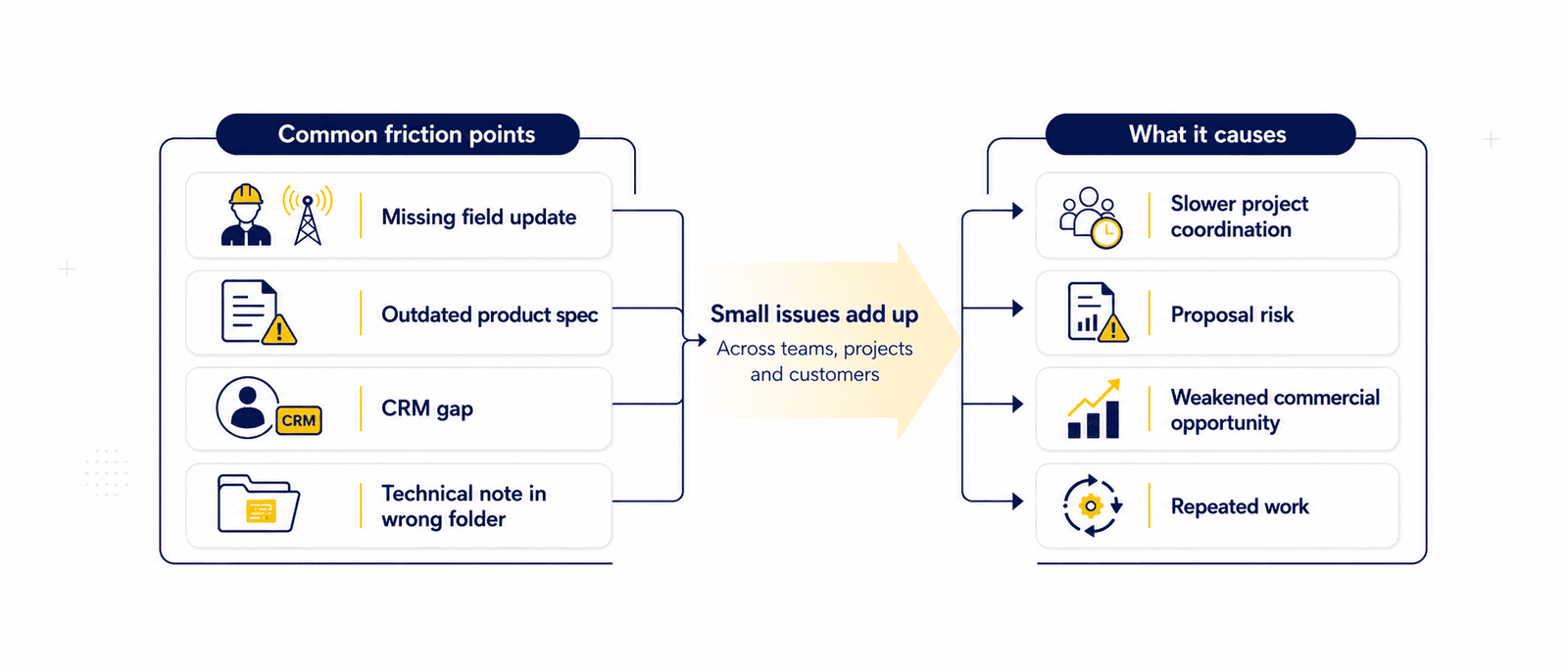
Small delays in information can quickly affect the pace of daily operations.
A missing update from the field can slow down a project manager. An outdated product specification can affect a proposal. A contact that is not properly tracked in the CRM can weaken a commercial opportunity. A technical note saved in the wrong folder can force another person to repeat work that was already done.
Individually, these situations may look minor. Across different teams, projects and customers, they create inconsistency.
When information is hard to find, teams lose time. When processes depend too much on memory, follow ups become less predictable. When field teams and office teams are not connected, decisions take longer. When documentation is not standardized, quality becomes harder to repeat.
Faster rollouts, better decisions and more consistent delivery depend on more than technical expertise. They also depend on systems that make everyday work clearer.
Faster rollouts need better coordination
Rollout projects involve planning, procurement, installation, approvals, documentation, customer communication and field execution. Experienced teams already know how complex this coordination can become.
Project management tools help when they reduce uncertainty. Platforms such as Asana, ClickUp, Trello, monday.com, Jira and Smartsheet can support task ownership, deadlines, project boards, rollout calendars and internal follow ups. Some of these platforms offer free entry plans, while paid versions usually add more advanced views, automation, reporting and governance features.
The value is not in having another dashboard. The value is in shared visibility.
Teams move faster when everyone can see what is pending, who owns the next step, what is blocking progress and what has already been completed. This reduces unnecessary status checks and gives project managers, sales teams, field teams and decision makers a clearer view of the work in progress.
The best coordination tools are the ones that help people spend less time asking for updates and more time moving projects forward.
Better decisions need better information
Good decisions depend on information that is accurate, accessible and easy to interpret.
In many companies, that information is spread across emails, spreadsheets, meeting notes, shared drives, CRMs, technical files and individual memory. The result is not always chaos, but it often creates delay.
Dashboards, CRM systems and reporting tools help turn scattered information into usable visibility. Looker Studio is a no cost tool for creating customizable dashboards and reports. Power BI also offers free account options for building and exploring reports. CRM platforms such as HubSpot and Zoho CRM provide accessible entry points for managing contacts, deals, tasks and customer follow up.
For telecom companies, this can support commercial follow up, campaign performance, project tracking, pipeline quality, recurring operational issues and technical planning.
The goal is not to create more reports. The goal is to make the right information available at the right moment.
A dashboard that no one uses adds no value. A CRM that is not updated becomes unreliable. A report that is too complex will not support faster decisions.
The most useful tools are the ones that simplify visibility without creating another layer of work.
More consistent delivery needs shared knowledge
Consistency does not happen just because teams are careful. It happens when the best way of doing something is easy to find, easy to repeat and easy to improve.
This is why knowledge management matters.
Tools such as Notion, Confluence, Microsoft SharePoint and Google Drive can help companies organize internal documentation, product information, installation guides, templates, decision records, FAQs, meeting notes and process instructions.

Notion supports company knowledge bases and team wikis, Confluence is positioned as a workspace for creating and sharing knowledge, SharePoint supports secure content collaboration, and Google Drive supports shared team storage.
For telecom teams, this can be especially useful for product specifications, installation instructions, internal technical notes, proposal templates, customer FAQs, quality checklists, field reporting standards, training materials, partner information and post event follow up processes.
This matters because telecom work often depends on accuracy. A small inconsistency in product data, installation requirements or customer information can create confusion later.
A good knowledge base reduces repeated questions. It also helps new team members onboard faster and allows experienced team members to spend less time answering the same operational doubts.
The result is not just faster work. It is more consistent work.
Field teams need mobile visibility
Delivery does not happen only in the office. A large part of operational quality depends on what happens in the field.
Field service management tools are relevant for operators, integrators and service providers because they connect scheduling, technician activity, work orders, customer data, field updates and reporting. Microsoft Dynamics 365 Field Service supports work orders and scheduling. Salesforce Field Service includes offline capability in its mobile app. ServiceNow offers Field Service Management for Telecommunications, and Praxedo positions its telecom field service platform around technician coordination, real time updates, work orders and field reporting.
For teams managing installations, repairs, preventive maintenance or customer service visits, this type of tool can reduce unnecessary calls, incomplete reports and delays between the field and the office.
The benefit is simple: field information becomes easier to capture, easier to standardize and easier to act on.
Network visibility needs reliable documentation
Accurate technical documentation is essential when networks grow in size and complexity.
Assets, routes, locations, IP data, connections and infrastructure records need to be reliable enough to support planning, troubleshooting and future expansion.
Network documentation and mapping tools can support this work. NetBox is positioned as a network source of truth combining IPAM and DCIM. Nautobot is an open source network source of truth and automation platform. QGIS is free and open source GIS software, while ArcGIS offers telecom specific GIS capabilities for network management, planning, reporting and documentation.
These tools are not necessary for every team in the same way. But the principle applies broadly: decisions improve when network information is reliable, updated and accessible.
Poor documentation creates uncertainty. Teams lose time confirming what exists, where it is located, what was installed and what needs to change.
Better documentation supports better planning, faster troubleshooting and more confident expansion.
Automation and AI should remove repetitive work
Automation and AI are useful when they reduce repetitive work and give people more time for higher value tasks.
Automation tools such as Zapier and Make can connect different apps and automate routine actions. Zapier’s free plan includes 100 tasks per month, while Make’s free plan includes up to 1,000 credits per month and access to a visual workflow builder with thousands of apps.
In practice, automation can help create CRM records from form submissions, send internal notifications when a lead reaches a certain stage, create tasks after meetings, update spreadsheets, send reminders, move files into the right folders or trigger follow ups after an event.
AI tools can also support daily work. Microsoft 365 Copilot can assist across Microsoft 365 apps, and Google Workspace with Gemini includes features such as meeting note capture and summarization in Google Meet.
For telecom teams, AI can help summarize technical documents, draft first versions of reports, organize meeting notes, extract action points, prepare campaign content, compare information and support internal knowledge search.
The important point is governance.
Teams should define what AI can and cannot be used for, especially when dealing with sensitive customer data, confidential commercial information or technical network details.
AI is most valuable when it is used responsibly, reviewed by experts and connected to clear business processes.
The best tool is the one that solves a real problem
There is no single app that makes a telecom company more efficient. The right starting point is not the tool. It is the friction.
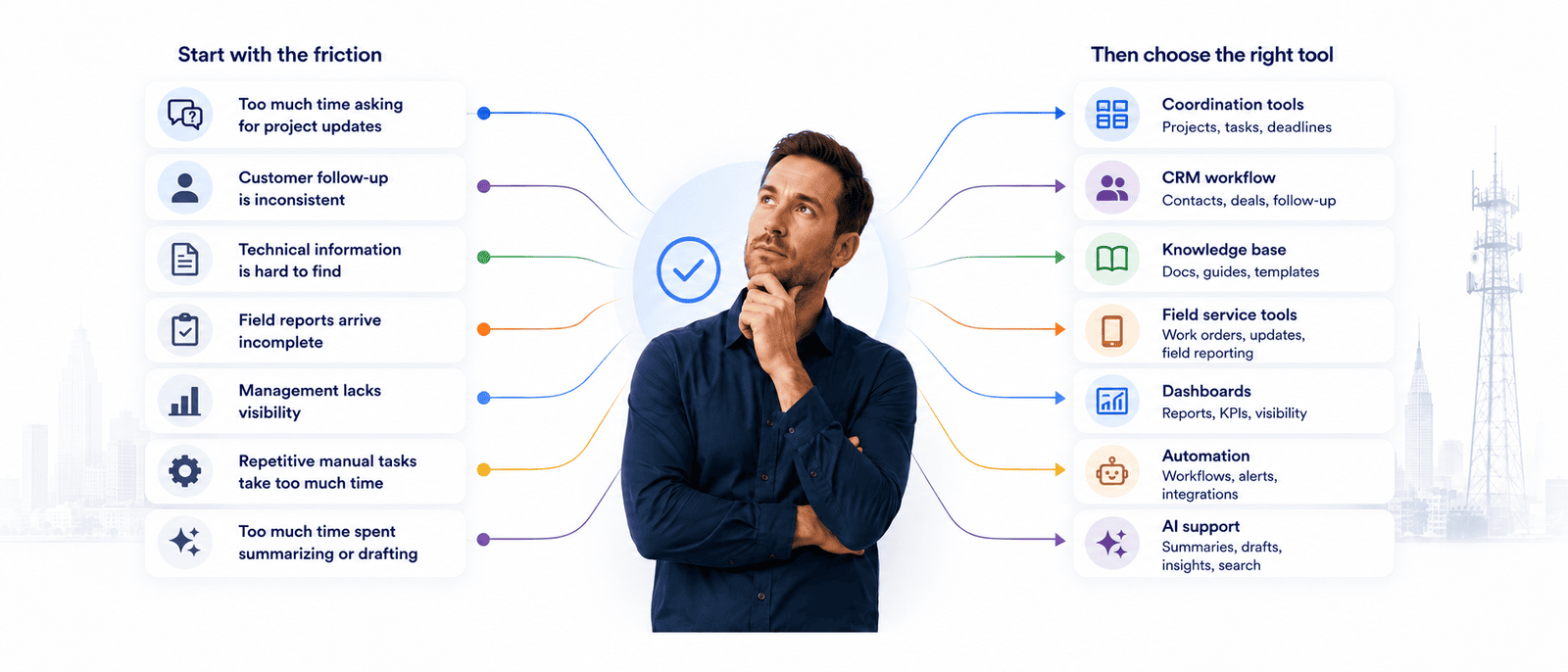
If teams lose time asking for project updates, the answer may be better task coordination. If customer follow up is inconsistent, the answer may be a clearer CRM workflow. If technical information is hard to find, the answer may be a knowledge base. If field reports arrive incomplete, the answer may be a mobile field service process. If management lacks visibility, the answer may be a dashboard. If repetitive tasks consume too much time, automation can remove part of that load. If teams spend hours summarizing, drafting or organizing information, AI can become a practical support layer.
The mistake is choosing tools because they are popular.
The right decision is choosing tools because they remove a real source of friction.
What telecom teams need now
Telecom teams do not need more noise, more meetings or more disconnected systems.
They need tools that make work clearer, workflows that make ownership visible, documentation that people can actually find, dashboards that support decisions, automation that removes repetitive work and AI that supports expertise without replacing it.
Most importantly, they need time to focus on what matters: customers, network quality, rollout progress, technical problem solving, commercial opportunities and long term business growth.
Faster rollouts, better decisions and more consistent delivery do not depend only on the technology inside the network. They also depend on the technology behind the teams.
The companies that will move with more confidence are the ones that combine telecom expertise with tools that simplify work, improve visibility and reduce operational friction.
Better tools give valuable teams more time to do their best work.