

The Digital Networks Act is not final law yet. But it is already important.
The European Commission adopted the proposal on 21 January 2026. That means this is no longer just a policy discussion. It is now a formal legislative proposal, and it shows where Europe wants its connectivity model to go next. The DNA is meant to modernise, simplify, and harmonise the legal framework for connectivity, with a stronger focus on advanced and resilient digital infrastructure.
For fiber infrastructure, the key point is simple: this proposal is about changing the rules around the next phase of network transition. That means a stronger push away from copper, a more harmonised market framework, and a clearer attempt to treat connectivity as strategic infrastructure, not only as a telecom service issue.
Why this proposal exists
Europe is still far from a fully completed connectivity transition. The Commission has pointed to major investment needs, estimating that achieving full connectivity across the EU by 2030 requires around €200 billion. At the same time, the internal market remains fragmented, which makes it harder for operators and providers to scale, invest, and compete across borders.
That is why the DNA matters. It is not just trying to update telecom rules, it is trying to create a framework that better suits Europe where fiber, 5G, cloud, AI, resilience, and digital sovereignty are becoming part of the same infrastructure discussion.
The real shift, from copper maintenance to fiber transition
The strongest part of the proposal is its direct push from copper to fiber.
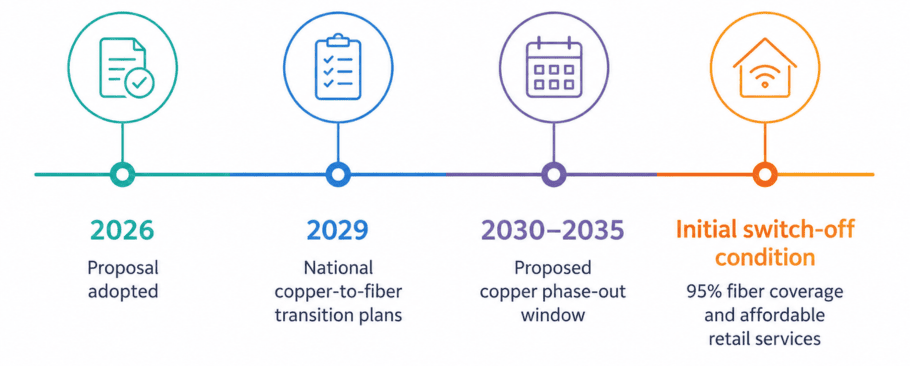
The Commission says the DNA will support and accelerate the transition from copper networks to a full fiber environment. The European Parliament’s legislative summary gives the operational detail: Member States would have to present national transition plans in 2029, explaining where copper will be switched off, by when, and which measures will support the move to fiber. The proposal sets the transition window between 2030 and 2035. In the first phase, copper switch-off would be required where two conditions are both met: at least 95% fiber coverage and the availability of affordable retail connectivity services. This is what makes the topic genuinely relevant.
The question is no longer only where fiber must still be deployed. It is increasingly how legacy networks will be retired without increasing cost, disruption, or regulatory uncertainty. That is a different kind of challenge. It brings migration planning, continuity of service, wholesale conditions, and dual-network economics into the centre of the discussion. That conclusion is an inference, but it follows directly from the structure of the proposal.
The market context makes this more urgent
This shift is happening in a market that is progressing, but unevenly.
Eurostat says that in 2024, FTTP covered 69% of EU households. Fixed very high-capacity networks reached 83% of EU households, while rural VHCN coverage remained lower at 62% . So Europe is not starting from zero, but it is also clearly not finished.62%. So Europe is not starting from zero, but it is also clearly not finished.
The country picture is also uneven. Italy reached 70.7% FTTP coverage, matching the EU average. Germany’s 2025 country report says FTTP availability still covers only a fraction of households, around half of the EU average. Belgium’s 2025 report says FTTP coverage remains below the EU average, especially in sparsely populated areas.
That matters because a Europe-wide fiber transition will not start from the same point in every market. Some countries are still focused on rollout gaps. Others are already closer to the harder question: what happens after coverage exists?
Portugal is a good example of why that distinction matters. Its 2025 Digital Decade country report says digital infrastructure is robust, with almost full 5G and gigabit coverage, but take-up is generally below the EU average. So even where infrastructure is strong, the challenge may shift from deployment to adoption, migration, and commercial activation.
The DNA is not the Gigabit Infrastructure Act
The strongest part of the proposal is its direct push from copper to fiber.
The Commission says the DNA will support and accelerate the transition from copper networks to a full fiber environment. The European Parliament’s legislative summary gives the operational detail: Member States would have to present national transition plans in 2029, explaining where copper will be switched off, by when, and which measures will support the move to fiber. The proposal sets the transition window between 2030 and 2035. In the first phase, copper switch-off would be required where two conditions are both met: at least 95% fiber coverage and the availability of affordable retail connectivity services. This is what makes the topic genuinely relevant.
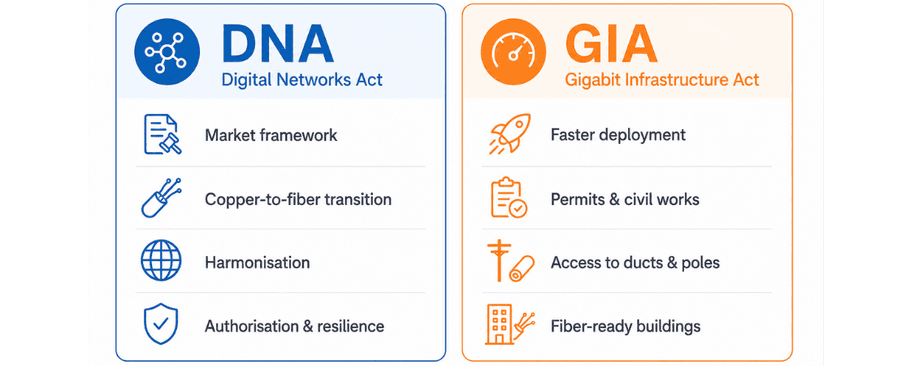
The DNA works at a different level. It is about the market and regulatory framework around connectivity: harmonisation, authorisation, resilience, access rules, and the copper-to-fiber transition.
The simplest way to put it is this: The GIA helps Europe build faster. The DNA is trying to shape how the next network model works.
What telecom companies should start reviewing now
This is the part that turns the article from interesting to useful.
The practical question is not whether the DNA will pass exactly as proposed. The practical question is whether networks, supply chains, migration plans, and passive infrastructure are ready for a more fiber-first operating model.
Here are the areas telecom companies should already be reviewing:
Copper overlap areas
- Identify where fiber coverage is already high and copper switch-off pressure could become realistic in the coming years.
Dual-network cost
- Quantify the OPEX of running copper and fiber in parallel. In many cases, the issue is not only deployment cost, but the long tail of maintaining legacy infrastructure while fiber is already available. This is an inference from the proposal’s transition model, but it is exactly the kind of issue the DNA brings closer to the surface.
Migration complexity
- Map where customer migration could be difficult, especially in multi-dwelling, enterprise, rural, or operationally fragmented environments. The more complex the installed base, the harder the transition becomes.
Passive infrastructure readiness
- Review whether closures, cabinets, ODFs, distribution points, and overall passive capacity are sized for future migration, not just today’s rollout phase. This is not stated as a checklist in the law, but it is a practical consequence of a more structured transition environment.
Take-up gaps
- In markets where coverage is strong but adoption is weaker, the challenge may be less about network reach and more about activation, packaging, affordability, or customer migration barriers. Portugal is a useful reminder of that.
Supplier and procurement readiness
- Review whether product availability, customisation capacity, and delivery timelines are aligned with faster migration cycles. If the market moves from slow expansion to more active transition, procurement timing becomes more important. This is an operational inference, but a realistic one.
Why this matters beyond regulation
The DNA also matters because it is part of a broader strategic framing. The Commission says rolling out advanced networks by 2035 could generate an accumulated GDP increase of about €400 billion and reduce CO2 emissions by 0.7 million tonnes. These are Commission estimates, not guarantees, but they show clearly how Brussels sees the issue: not as a narrow telecom adjustment, but as part of Europe’s wider competitiveness and resilience agenda.
What we can already conclude
The final text can still change. But the direction is already clear.
Europe is moving toward a more structured fiber-first model. Not one based only on fresh deployment, but one based on transition. That includes copper switch-off, stronger harmonisation, more predictable framework conditions, and a broader view of connectivity as strategic infrastructure.
That is why this topic deserves attention now.
The most useful takeaway is not just “keep an eye on it.” It is this: Europe’s next fiber phase will be shaped not only by rollout, but by how the transition away from legacy networks is governed.
For operators, suppliers, integrators, and infrastructure partners, that can influence planning, migration strategy, procurement timing, and investment decisions well before the law is final.

Article by