
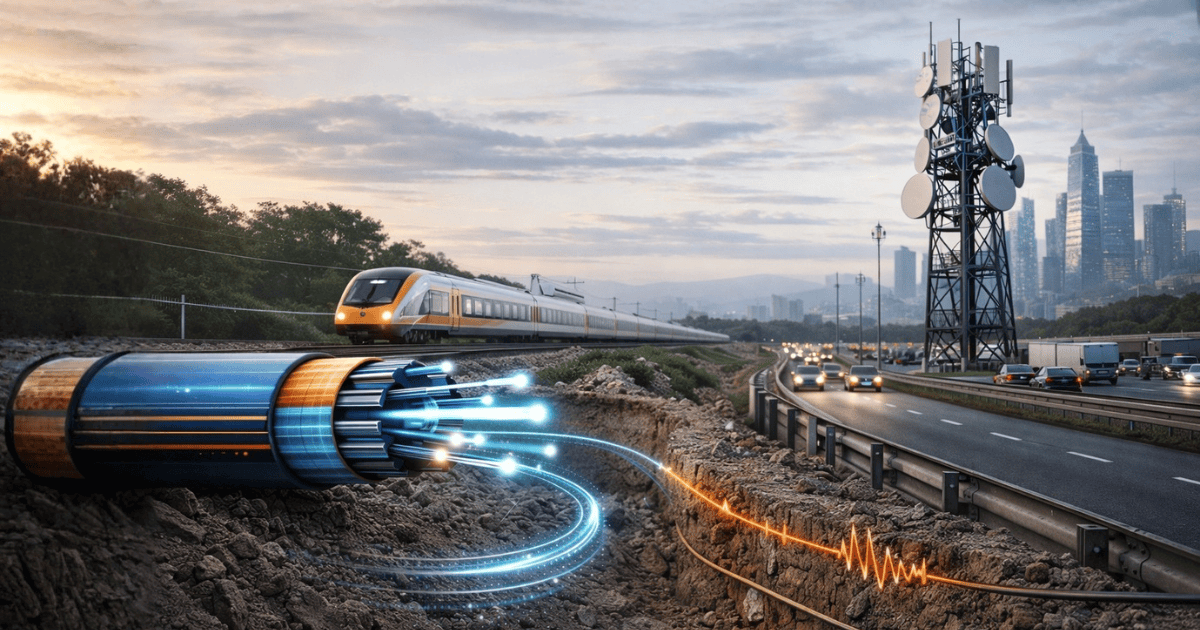
A practical introduction to how optical fiber can evolve from passive transport infrastructure into a continuous sensing layer for telecom networks.
Optical fiber has long been treated as a transport medium. Its job was clear: carry growing volumes of traffic, across greater distances, with low loss and high reliability. That role has not changed. What has changed is the industry’s understanding of what fiber can also do.
Fiber sensing adds a second dimension to optical infrastructure. In the right technical conditions, the same fiber that carries communications can also help detect vibration, temperature variation, strain, and other physical disturbances along its route. That is what makes the subject strategically important for telecom. As fiber footprints grow and infrastructure resilience becomes more critical, the value of a network is no longer defined only by capacity and coverage.
The OECD says fiber represented 47% of total fixed broadband subscriptions across OECD countries by the end of 2024, while FTTH Council Europe reported 295 million FTTH/B homes passed and 160 million subscribers in the EU39 by September 2025. In other words, fiber is already everywhere that strategic digital infrastructure needs to be.
1. Fiber can do more than carry data
The first principle is the most important: fiber sensing does not replace the communications role of optical fiber, it expands it.
In a conventional network, the fiber is there to transmit information between endpoints. In a sensing environment, the fiber can also provide information about the physical world around it. That shift matters because it changes how operators and infrastructure owners can think about route value. A cable path is no longer only a connection between A and B. Under the right conditions, it can also become a source of operational awareness. VIAVI describes distributed fiber optic sensing as an approach in which the fiber itself acts as the sensor, creating continuous sensing points along the route.
2. Fiber sensing is based on measurable physics, not on a vague “smart infrastructure” idea
A lot of market language around fiber sensing becomes too abstract too quickly. The reality is much more concrete.
Fiber sensing works by sending light through the fiber and analyzing how the light changes as it interacts with the cable and its environment. Different scattering effects respond to different physical conditions. In the ITU tutorial on distributed fiber sensing, Rayleigh backscatter is associated with vibration and acoustic sensing, Raman with temperature sensing, and Brillouin with temperature and strain sensing. IEC’s distributed acoustic sensing standard also identifies Rayleigh backscatter as the basis for the DAS systems covered by that standard.
That matters for telecom decision-makers because it keeps the discussion honest. Fiber sensing is not a generic digital layer that can detect anything, anywhere. It is a set of optical measurement techniques, each suited to different kinds of physical events.
3. A single fiber route can act like a distributed sensing layer
One of the strongest reasons fiber sensing is so relevant to infrastructure environments is scale.
Traditional monitoring systems often depend on fixed points. A camera sees what is in its field of view. A point temperature sensor measures a specific location. A vibration sensor works where it is installed. Fiber sensing introduces a different model. Because the fiber extends continuously along a route, the sensing system can generate spatially resolved measurements along that route rather than only at isolated points.
That is why the technology is especially relevant for long, linear infrastructures such as telecom corridors, transport routes, utilities, tunnels, and industrial assets. FOSA describes DAS as producing real-time, spatially resolved vibration and acoustic output from hundreds of thousands of virtual points along a fiber optic cable. Corning similarly notes that optical cable can create very large numbers of virtual sensors over one to tens of kilometers.
For telecom operators, this is the real conceptual shift. A network route can move from being something you manage logically to something you can also observe physically.
4. Fiber sensing is becoming more relevant because fiber is becoming more strategic
The business relevance of fiber sensing is not coming only from the sensing technology itself. It is also coming from the growing importance of the infrastructure under observation.
European telecom and digital infrastructure are now expected to be more resilient, more secure, and better governed than before. The European Commission states that NIS2 creates a common cybersecurity framework across 18 critical sectors and raises requirements around risk management and incident reporting. ENISA reported 188 significant telecom security incidents in 2024, a 20.5% increase from 2023. These figures do not prove that fiber sensing is the answer to every resilience challenge, but they do reinforce a broader market reality: passive infrastructure is no longer enough when services, public systems, and business operations depend so heavily on continuous connectivity.
For telecom leaders, the implication is straightforward. The more strategic the network becomes, the more valuable route awareness becomes.
5. The value of fiber sensing is operational, not theoretical
The most credible way to understand fiber sensing is to ask what it improves operationally.
A conventional network management system can usually tell an operator that service has degraded or failed. It does not always provide early visibility into what is happening physically along the route. Fiber sensing can help fill part of that gap by detecting events or conditions near the cable path, depending on the sensing method and deployment environment.
Nokia highlighted this practical value in a Bell Labs field trial performed over a 524 km live aerial fiber network, where communication fibers were used as environmental sensors to provide earlier warning of possible network failure. NEC Labs and Verizon also demonstrated field sensing over existing telecom infrastructure, including simultaneous monitoring across four fiber routes with one system. Those examples matter because they show that the concept is not theoretical. Existing telecom infrastructure can support sensing use cases, provided the technical conditions are right.
For the telecom market, that means fiber sensing should be assessed as an operational capability: not as a slogan, but as a potential tool for improving awareness, investigation, and response.
6. Fiber sensing does not remove technical limits
This is where serious industry content must be more disciplined than marketing copy.
Fiber sensing is not automatically effective on every route, with every cable, or for every event. Performance depends on the sensing technique, interrogator quality, cable construction, installation method, acoustic or thermal coupling to the environment, background noise, route topology, and the quality of event classification.
Industry and standards sources are clear on this point. Different backscattering methods are used for different measurands, and DAS standards do not cover every possible operating mode or every kind of system architecture. That means operators should begin with the operational question first, then assess whether the fiber, route, and sensing method are appropriate for that use case.
That is also why pilots matter. A serious pilot does not only prove detection. It helps validate location accuracy, false alarm behavior, environmental sensitivity, and whether the sensing output can actually support field decisions.
7. The strongest telecom use cases start with the route, not the technology name
The most common mistake in early fiber sensing discussions is to start with the acronym. DAS, DTS, Rayleigh, Raman, Brillouin, and other technical concepts matter, but they are not the first question most operators should ask.
The better starting point is this: which routes matter most, what kinds of events need to be detected, and what would the business gain from earlier physical awareness?
That route-first logic is what makes fiber sensing useful for telecom strategy. It helps focus the discussion on practical outcomes such as service continuity, route protection, infrastructure intelligence, and better coordination with stakeholders responsible for transport, utilities, or critical sites. ETSI’s work on F5G Advanced reinforces that optical infrastructure is increasingly being viewed as relevant not only to telecom but also to transport, energy, manufacturing, and broader vertical applications.
In other words, the technology becomes valuable when it is tied to a real operational problem.
Fiber sensing matters because it expands the role of optical infrastructure at exactly the moment when fiber networks are becoming more widespread, more strategic, and more closely tied to resilience.
The market context is already clear. Fiber is now a dominant fixed broadband medium in OECD markets, and FTTH/B deployment across Europe continues to grow at scale. At the same time, telecom and critical infrastructure operators are being asked to manage more risk, more dependency, and more accountability.
That is why fiber sensing deserves attention from telecom professionals.
- Not because it turns every cable into a miracle sensor.
- Not because it replaces traditional monitoring systems.
- Not because every route will deliver the same performance.
It matters because it gives the industry a realistic path to extract more operational value from infrastructure that already exists.
For telecom leaders, that is the real insight: fiber can remain the foundation of connectivity while also becoming a source of route intelligence. The companies that will benefit most are not the ones that treat fiber sensing as a trend. They are the ones that define the right routes, the right events, the right sensing method, and the right operational workflow before they scale.